A professional mold inspection should include a whole-property visual and moisture investigation by a licensed assessor, instrument readings with a moisture meter and thermal imaging, documented indoor and outdoor humidity and temperature, a clear decision about whether laboratory sampling is warranted, and a written report with photographs, findings, an interpretation, and ranked next steps. Anything less is a walkthrough.
That is the standard. What follows is how to hold any inspector to it, because the phrase "mold inspection" has no fixed meaning in the marketplace. In our work across the Treasure Coast and Palm Beach County we regularly read reports from other companies that a client brought us for a second opinion, and the range is startling. Some are sixty pages of room by room documentation. Some are a one page form with three photographs and a remediation quote stapled to the back. Both were sold as a mold inspection. This note is written so you can tell the difference before you pay.
What does a mold inspector actually do on site?
A competent inspector spends the visit looking for water and for the conditions that let water linger, because mold is a symptom and moisture is the cause. The visible growth you called about is one data point. The inspection is everything around it.
The visit should begin with a conversation, not a flashlight. A good inspector wants to know what you have noticed and when, whether there is an odor and where it is strongest, whether anyone in the home is dealing with symptoms their physician associates with damp environments, whether there have been leaks or storm intrusion, whether any previous remediation has been done and by whom, and how the air conditioning behaves. Those answers shape where the inspector looks hardest. An inspector who skips the intake is guessing.
Then the whole property gets walked. Not the room you pointed to, the whole property. That means every window and door perimeter, the base of every exterior wall, under every sink, behind and beneath the water heater, the laundry area, the air handler closet and the ductwork visible from it, every bathroom ceiling and every wall that backs onto a shower, the attic access and the attic itself where it can be entered safely, and the exterior, including grading, gutters, roof edges, and the stucco or siding at ground level. In a Fort Pierce or Port St. Lucie home the closets on exterior walls get particular attention, because they are the classic spot where humid air and a cool wall meet with no airflow to break it up.
Throughout the walk the inspector is reading the building. Stains and their shapes, since a leak from above stains differently than wicking from below. Paint that has bubbled, chalked, or been recently touched up, since fresh paint over an old stain is one of the most common things we find in rentals and in homes being sold. Baseboards that have swollen or separated. Flooring that cups or feels soft. Efflorescence on block. Rust on fasteners. The condition of caulk and grout. The smell in a closed closet. None of that requires a laboratory, and all of it is inspection.
What instruments should a mold inspection include?
At minimum, a moisture meter, a thermal imaging camera, and a hygrometer, and the inspector should be able to explain what each reading means and what it does not.
A moisture meter is the instrument that separates active problems from history. A stain on a ceiling tells you water was there at some point. A meter reading on that stain tells you whether the drywall is wet today. Pin meters read the material directly, pinless meters scan a wider area without leaving marks, and a serious inspector carries both. The reading gets recorded and, when it matters, compared against a dry reference reading elsewhere on the same material, because the number on its own is only half the information.
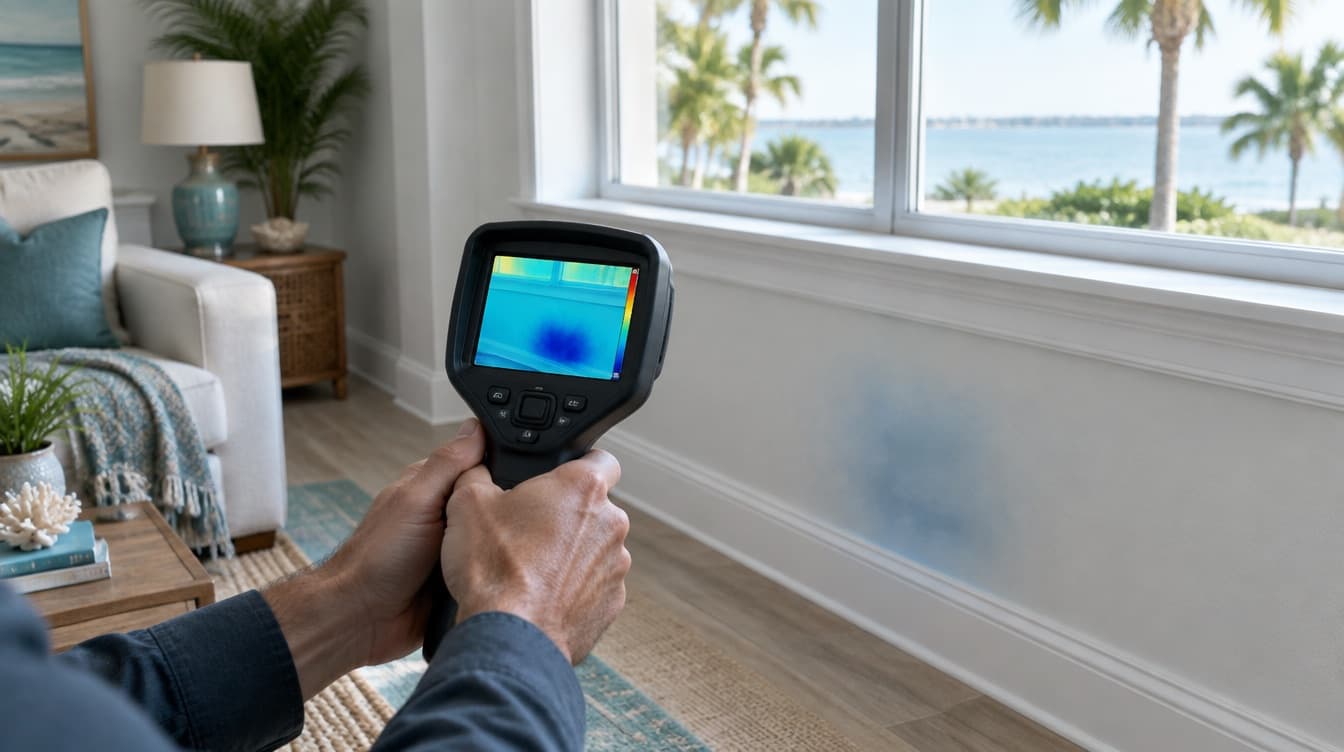
Thermal imaging is the instrument that lets an inspector scan a whole wall or ceiling in seconds. It does not see moisture. It sees temperature, and wet materials tend to read cooler because of evaporation, so a cold patch on a wall with no obvious reason is a place to put the moisture meter. On our inspections thermal imaging goes across the entire property rather than only the area of concern, because the second problem is usually not where the client is looking. The inspector should be honest about the limits, since a cold spot can also be a duct, a missing patch of insulation, or a stud. Thermal imaging finds candidates. The meter and the eyes confirm them.
A hygrometer captures relative humidity and temperature, indoors and outdoors, at the time of the visit. This gets skipped constantly and it matters more in coastal Florida than anywhere else in the country. If the living room is reading sixty two percent humidity while the air conditioner is running, the mold on the closet wall is not a leak problem, and any lab result taken that day has to be read in that light. Our note on what indoor humidity should be in coastal Florida explains the targets.
Beyond those three, a good inspector carries a strong flashlight, a camera capable of clear close up photographs, a borescope for looking inside cavities through small existing openings, and the sampling equipment discussed below. Sterling's assessor has personally completed more than three hundred inspections since January 2026, and the instrument kit is the same on every one of them, because the property decides what gets used, not the price of the package.
Should a mold inspection include air sampling?
It should include a decision about sampling, made for a reason and explained to you, and it should include sampling itself only when a laboratory result will answer a question the inspection cannot.
This is the part of the standard most often gotten wrong in both directions. Some companies sample every job as a matter of routine, which inflates the invoice and produces numbers that get over interpreted. Others never sample, which leaves the client without evidence when evidence is exactly what the situation calls for.
The professional pattern looks like this. When there is no visible growth, no odor, and no complaint, sampling usually is not warranted, and the report should say so in plain words rather than leaving the question open. When there is a musty odor with no visible source, air sampling can compare indoor spore levels and types to an outdoor control and point toward hidden growth. When growth is visible and the question is what it is, a surface sample is the cleaner tool and usually the cheaper one. When remediation is going to happen, a sample taken beforehand becomes the baseline that clearance is later measured against. When a tenant, buyer, seller, or insurer is going to rely on the result, lab confirmation carries weight that a photograph does not.
Air sampling done properly has its own standard. An indoor sample is only interpretable against an outdoor control taken the same day, because outdoor spore counts on the Treasure Coast swing with the season and the weather. There should be at least one indoor sample per air handler zone if the question is about the whole house. The air conditioning should be running normally during sampling so the result reflects the air people actually breathe. Nothing should be disturbed, vacuumed, or fogged immediately beforehand. And the inspector should be able to tell you what a spore trap measures and what it cannot, which is covered in depth in our note on how to read your mold lab report.
If the inspector cannot articulate why a sample is being taken, the sample is padding.
What should the mold inspection report include?
The report should let a person who was not in the house understand what was found, where, how wet, why, and what to do about it in what order. It should be usable by a remediator, a landlord, a seller, an insurer, or an attorney without a phone call to the inspector.
At minimum it should record the inspection details, meaning who was present, what the complaint was, the weather, the building type, and the indoor and outdoor temperature and humidity. It should document the air conditioning system and its condition as observed, because the air handler is implicated in a large share of Florida moisture problems. It should go room by room through the areas inspected with labeled photographs, moisture readings where they were taken, and thermal images where they revealed something. It should include a moisture control and prevention section, so the reader understands the habits and settings that keep the house dry after the immediate problem is handled. It should state its scope and its limits honestly, including that a non invasive inspection cannot see inside sealed wall cavities and that any use of the word mold is a visual observation until a laboratory confirms it. And it should close with conclusions and recommendations that are ranked in the right order, which is always source control first, then drying and material decisions, then cleaning, then verification, then maintenance.
When sampling was performed, the report is accompanied by a chain of custody form showing how the sample traveled to the lab, the laboratory's own result sheet, and a written addendum from the assessor interpreting those results against what was observed in the home. The lab report on its own is a table of numbers. The addendum is where a professional explains what the numbers mean for this house and these occupants.
You can see exactly what that looks like in Sterling's sample report. Ask any inspector you are considering for theirs. If the sample report is thin, the real one will be too.
What a mold inspection should not include
It should not include a remediation quote from the same company, and it should not include fear.
Florida licenses mold assessors and mold remediators separately and its statute prohibits a licensed assessor from performing remediation on a property they assessed within the previous twelve months. It also prohibits referral fees between assessors and remediators in either direction and bars contingent fee inspections where the payment depends on the finding. The full text and what each paragraph means when you hire is on the Florida mold law page. The practical standard is simple. The person diagnosing the problem should have nothing to gain from the size of the diagnosis. When an inspection ends with a cleanup estimate from the same truck, you did not receive an independent inspection, whatever the invoice says.
The other thing a professional inspection should not include is alarm. Every occupied home in coastal Florida has some mold somewhere if you look hard enough at a window track or a shower ceiling. A professional distinguishes between a surface condition with an obvious cause and a genuine moisture problem, and says so plainly. Some of the most useful reports we write conclude that the situation is minor and can be handled by the homeowner.
A few more boundaries are worth knowing before the visit. An inspection is not a health diagnosis: certain symptoms are associated with damp indoor environments and we describe conditions honestly, but connecting anyone's symptoms to a spore type is a conversation for their physician. It cannot certify a house as mold free, because spores are present in outdoor air everywhere in Florida and come indoors on every open door; the realistic goal is no active growth, no elevated moisture, and no unexplained indoor levels compared with outdoors. It works with accessible areas, so opening a wall, pulling a cabinet toe kick, or lifting flooring needs your authorization, and when the evidence points inside an assembly the report says so and explains what opening it would resolve. It does not price the repair, which is a contractor's job. And it does not replace a general home inspection: it covers moisture and microbial conditions, not structure, electrical, roof, or code.
How to hold your inspector to this standard
Before booking, ask three things and listen to how the answers are given. Ask what instruments will be used and whether the whole property will be inspected or only the area of concern. Ask how the decision to sample will be made and what each sample costs. Ask to see a sample report. Then ask the question that decides everything, which is whether the company would perform the remediation on your house or is paid by anyone who would.
During the visit, notice whether the inspector asks you questions before picking up a tool, whether every room gets attention, whether readings are being recorded rather than glanced at, and whether the inspector explains what is being seen as the visit goes. A professional narrates. It is how you learn your own house.
After the visit, read the report against the list above. If it lacks climate readings, if the photographs are unlabeled, if there is no moisture data, if the recommendations are a single sentence, or if the conclusion is a sales pitch, you have grounds to ask for more or to seek a second opinion.
Sterling's inspections are built to this standard on every visit, whether the concern is a single stain in a Stuart condo or a whole house in Palm Beach Gardens, and the process page walks through the visit step by step. If we inspect your home, Florida law bars us from remediating it for twelve months, and we take no referral fees, which is what allows the report to say whatever the house says. If you would like to talk through whether your situation warrants sampling before you book, request a quote and we will tell you honestly.
Frequently asked questions
What does a professional mold inspection include?
A professional mold inspection includes an intake conversation about odors, symptoms, leaks, and prior remediation, a visual and moisture investigation of the entire property, moisture meter and thermal imaging readings, documented indoor and outdoor humidity and temperature, a reasoned decision about whether air or surface sampling is warranted, and a written report with labeled photographs, findings, interpretation, and recommendations ranked from source control through verification.
Does a mold inspection include air quality testing?
Only when a laboratory result will answer a question the inspection itself cannot, such as whether indoor spore levels differ from the outdoor baseline when there is an odor with no visible source, or establishing a baseline before remediation. A professional inspector explains the reason for each sample and states plainly when no sampling is needed. Air quality testing is priced per sample and is not automatic.
What should a mold inspection report look like?
A proper mold inspection report records the inspection conditions and climate readings, documents the air conditioning system, goes room by room with labeled photographs and moisture readings, includes a prevention and moisture control section, states its scope and limitations, and closes with ranked recommendations. When samples were taken it is accompanied by a chain of custody form, the lab result sheet, and a written addendum interpreting the results for that specific home.