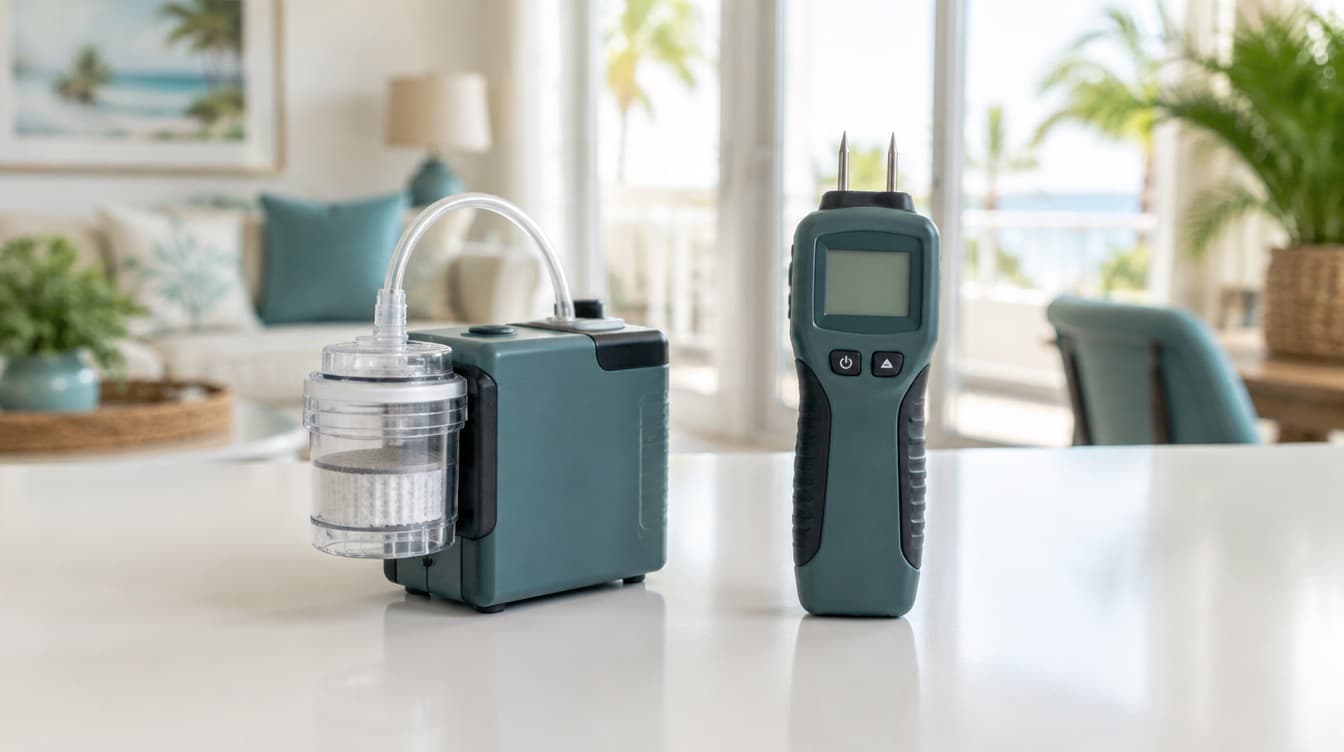
A mold inspection is the investigation of a property for moisture and growth using a trained eye, a moisture meter, thermal imaging, and climate readings. Mold testing is laboratory analysis of air or surface samples taken during that inspection. Nearly everyone needs the inspection. Only some situations need the testing, and the right way to decide is by the question you need answered, not by what a company sells by default.
That distinction gets blurred constantly, and the blurring costs people money in both directions. Some pay for air samples that told them nothing they could not see, and some skip sampling in exactly the situation where a lab result was the only thing that would have carried weight. This note is a decision guide. It takes the situations we hear most often on the phone from Vero Beach to Boca Raton and works through which service each one actually calls for.
What does a mold inspection tell you that testing cannot?
An inspection tells you where the water is, which is the only thing that ever gets fixed. Testing tells you what is in the air or on a surface at one moment. Those are different questions, and the first one is almost always the one that matters.
Mold is a symptom. It grows where building materials or the air stay damp long enough, and it stops growing when they dry. An inspection is the search for that dampness. The inspector walks the whole property with a moisture meter and a thermal camera, reads every window and door perimeter, the base of every exterior wall, under every sink, the laundry, the water heater, the bathrooms, the closets on exterior walls, the air handler and its drain line, the attic where it can be entered, and the exterior grading and stucco. Indoor and outdoor humidity and temperature get recorded, because in coastal Florida the air itself is the cause of a large share of growth. The report that comes out of that says where the moisture is, whether it is active, why it is there, and what to do about it in what order. Our overview of what a mold inspection includes in Florida describes the full scope.
No laboratory result does any of that. A spore count from the living room does not tell you the condensate line is clogged. A swab result that says the growth on the closet wall is a common water damage genus does not tell you that the wall is cold because the air conditioner is oversized and the humidity has been sitting at sixty four percent all summer. Testing without inspection produces a number with no story. Inspection without testing produces the story, and often that is enough. When a client in Stuart sends us a lab report from another company and asks what it means, the first thing we ask is what the inspector found in the house, and the most common answer is that nobody looked. The number cannot be interpreted without that, and the money spent on it was spent in the wrong order.
What does mold testing tell you that an inspection cannot?
Testing tells you what genus the growth is, whether the indoor air differs from the outdoor baseline, and it gives you a document from an accredited laboratory that a third party will accept as evidence. Those three things are real, and there are situations where each one is the whole point.
Identity matters when the type of growth changes the decision. The genera the laboratory associates with water damaged buildings signal chronic wetting in a way that common outdoor types blowing in through a door do not. When someone in the home is sensitive, when a physician has asked what is present, or when a remediation scope depends on what was growing, a surface sample settles the identity question in a way no photograph can.
Comparison to outdoors matters when the question is whether the house is amplifying mold internally. An air sample from inside compared against an outdoor control from the same day shows whether the indoor spore types and counts look like the outdoor air, which is normal, or look different, which points toward an indoor source. That is the tool for a musty odor with nothing visible, and our note on when air sampling is actually useful goes into its strengths and its limits.
Evidence matters when the result will be handed to someone who was not in the house and who has a reason to doubt you. A landlord, a seller, an insurer, an association, an opposing attorney. A licensed assessor's report with a chain of custody form and an accredited lab result attached is a document those people have to answer. A photograph of a dark spot on a wall is not. We have watched one lab result change a landlord's response from dismissal to a repair order, and that shift is the value of testing in those situations.
Testing also has honest limits, and a good assessor states them. A spore trap air sample is a snapshot of a few minutes in one location. It cannot tell live spores from dead ones, does not measure the chemical compounds that cause odor, and can miss growth sealed inside a wall that is not releasing spores into the room at the moment the pump runs. A not elevated result in a house with a wet wall is a favorable data point, not an all clear. Our note on how to read your mold lab report covers what the numbers mean and do not mean.
Which do you need in each common situation?
You have a musty smell and cannot find the source. You need the inspection first, and you probably need air sampling with it. The inspection hunts for the moisture with instruments and often finds it, in which case the odor is explained and sampling adds little. When the inspection cannot locate a source, an indoor air sample against an outdoor control tells you whether the house is amplifying something and can point toward the zone. Our note on tracking a musty smell with no visible mold describes that investigation.
You can see growth and you know why it is there. You need the inspection to confirm the cause and check the rest of the house, and you usually do not need testing. Growth on a bathroom ceiling above a shower with a dead exhaust fan does not become more actionable with a lab result. Fix the fan, clean the ceiling, watch it. An honest inspector says this out loud and the report says it in writing.
You can see growth and you need to prove what it is to someone else. You need the inspection and a surface sample of the visible growth. A swab or tape lift of the material itself identifies the genus at lower cost than an air sample and gives a tenant, a buyer, or a claimant the species documentation that makes the dispute real. This is the single most common situation in which we recommend a surface sample over an air sample, and we recommend against disturbing or cleaning the growth until it has been documented.
You are buying a house. You need the inspection nearly always, and testing depends on what it finds. A clean inspection with no findings produces a clean report for your file and does not need samples. Findings with an obvious cause produce a repair list and usually do not need samples. A musty odor with no source, or growth whose extent is unclear, or a seller who is going to be asked to remediate, calls for sampling because the result will be used in negotiation. Our note on whether you need a mold inspection when buying a home has the decision framework and the timeline.
You are about to have remediation done. You need the inspection to define the scope in writing, and you need a sample taken beforehand as the baseline. Clearance testing after the work is only meaningful against a baseline, and a written protocol from an independent assessor is what keeps the remediator's scope honest. The mold clearance testing page explains the sequence.
Remediation was just completed and you want to know it worked. You need clearance testing, which is a focused inspection of the work area plus sampling compared against the baseline and the outdoor control. Visual sign off from the remediator is not clearance. Our note on what passing clearance testing means covers what a pass actually proves.
Someone in the home has symptoms a physician associates with damp environments. You need the inspection, and testing is usually warranted because the physician benefits from a documented air result and because the identity of any growth matters more when an occupant is sensitive. The result is framed carefully, since an assessor is not a medical provider, and the report describes what is present and what the physician can do with it.
You just want to know the house is fine. You need the inspection, and you should be told plainly if sampling is not warranted. Many of the reports we write conclude exactly that, and the value of those reports is that they say so in writing from a licensed assessor with no reason to say otherwise.
Why "testing only" is usually a mistake
Because a number without an investigation has no story, and because the companies that sell testing as a standalone product are often using it as the entry point to a remediation sale.
A homeowner in Jupiter calls a company that advertises mold testing. A technician arrives, runs an air pump in two rooms and one outside, leaves, and a week later emails a lab report with a highlighted line and a remediation quote. Nothing in that sequence found the moisture. Nothing in it walked the attic or looked at the air handler or read the humidity. The homeowner has a number, a fear, and a quote, and the growth will come back after the cleanup because the source was never found.
Florida law separates mold assessors from mold remediators and prohibits referral fees between them for exactly this reason, and the Florida mold law page quotes the statute. Independence is what makes the testing decision honest. If Sterling inspects your home, Florida law bars us from remediating it for twelve months, and we take no referral fees, which is why our recommendation is allowed to be "no sampling needed here" as often as the house warrants it.
How Sterling structures the choice
The inspection is the foundation and it is the same on every visit regardless of package. Whole property, moisture meter, thermal imaging across every room, climate readings, air handler and attic, labeled photographs, and a written report with ranked recommendations. Sampling is the decision layered on top, made for a reason, and priced per sample so that it is never padding. When the question is what is in the air, an indoor sample and an outdoor control are the tool. When the question is what this growth is, a surface sample is the tool. When there is no question a laboratory can answer, the report says so.
Sterling's assessor has personally completed more than three hundred inspections since January 2026 across the Treasure Coast and Palm Beach County, and on a meaningful share of them the honest recommendation was that no testing was needed. The pricing page lays out how the inspection and the sampling are priced separately, and the process page shows the visit. If you are unsure which your situation calls for, request a quote and describe what you are seeing and why you are asking. We will tell you plainly before anything is booked.
Frequently asked questions
What is the difference between mold testing and a mold inspection?
A mold inspection is the on site investigation of a property for moisture and growth using a trained visual survey, a moisture meter, thermal imaging, and indoor and outdoor humidity readings, producing a written report on where the moisture is and what to do about it. Mold testing is laboratory analysis of air or surface samples collected during an inspection, which identifies spore types and compares indoor air to an outdoor control. The inspection finds the cause. Testing documents what is present.
Do I need mold testing or just an inspection?
Nearly every situation needs the inspection, because it locates the moisture that has to be fixed. Testing is warranted when a laboratory result answers a question the inspection cannot, such as identifying the type of visible growth for a tenant or buyer dispute, comparing indoor air to outdoor air when there is a musty odor with no visible source, establishing a baseline before remediation, or providing clearance after it. When the growth is visible and the cause is obvious, testing usually adds nothing.
Is a mold test without an inspection worth it?
Rarely. A laboratory result without a moisture investigation is a number with no explanation, because it does not locate the source, and the source is the only thing that gets fixed. Testing only services are frequently the entry point to a remediation sale. A licensed independent assessor performs the inspection first and adds sampling only when it will answer a specific question, which keeps both the cost and the interpretation honest.