Glossary
Mold & water damage, in plain English.
The terms you'll meet in mold reports, remediation estimates, and water damage paperwork, and the other names people use for them.
Short answer
Mold remediation is also called mold removal or mold abatement; drywall is also called sheetrock; Category 3 water is also called black water. This glossary defines 79 terms from inspection, testing, remediation, and water damage work, with the other names each one goes by and the Florida law behind the licensing terms.
Mold & moisture basics
- Mold
- Also called: mould, fungus, fungal growth, microbial growth
- A fungus that grows on damp organic material, such as the paper on drywall, wood, and household dust, and spreads by releasing microscopic spores. Indoors, mold needs moisture to grow, so every mold problem starts as a moisture problem. Florida law defines it as "an organism of the class fungi that causes disintegration of organic matter and produces spores, and includes any spores, hyphae, and mycotoxins produced by mold" (§ 468.8411).
- Learn more
- Mildew
- Also called: mold and mildew, bathroom mildew
- A common name for mold growing flat on a surface, usually white, gray, or light brown and powdery, often in bathrooms and closets. Mildew is still mold. The name describes how it looks, not a separate, harmless organism.
- Learn more
- Spores
- Also called: mold spores, spores in the air
- The microscopic particles molds release to reproduce. Spores are in indoor and outdoor air all the time. A problem shows up as growth indoors, or as indoor spore types and levels that don't match the outdoor air.
- Learn more
- Hyphae
- Also called: hyphal fragments, mycelium
- The thread-like filaments a mold grows as it spreads through a material. Lab reports sometimes list hyphal fragments separately, because pieces of growth can show up in an air sample even when intact spores don't.
- Mycotoxins
- Also called: mold toxins, toxic mold
- Chemical compounds that some molds can produce under some conditions. Finding a mold doesn't by itself mean mycotoxins are present. Questions about exposure and health belong with a physician; Sterling documents building conditions, not medical ones.
- Black mold (Stachybotrys)
- Also called: toxic black mold, Stachybotrys chartarum, black mould
- An informal name, usually meaning Stachybotrys chartarum, a greenish-black mold that grows on materials that stay wet for a long time, like drywall paper. Many molds look black, so color alone can't identify it; only a lab can.
- Learn more
- Aspergillus / Penicillium
- Also called: Asp/Pen, Penicillium/Aspergillus-like
- Two of the most common mold groups found indoors. On air-sample (spore trap) reports they're usually counted together as "Aspergillus/Penicillium-like," because their spores look alike under a microscope.
- Learn more
- Cladosporium
- One of the most common molds in outdoor air. Because it's everywhere outside, a lab report's indoor Cladosporium count only means something next to the outdoor count taken the same day.
- Chaetomium
- A mold associated with long-term water damage to drywall paper and wood. Finding it indoors usually points to materials that have been wet for a while, not a one-day leak.
- Possible microbial growth
- Also called: suspected mold, apparent microbial growth, PMG
- The phrase home inspectors often use when they see something that looks like mold, because identifying mold is outside a general home inspection. It's a prompt to have a licensed mold assessor look at it, not a diagnosis.
- Learn more
- Musty odor (MVOCs)
- Also called: musty smell, moldy smell, mildew smell, damp smell, microbial volatile organic compounds
- The earthy, stale smell many people notice with mold. It comes from gases molds release as they grow, called microbial volatile organic compounds (MVOCs). A musty smell with no visible growth is one of the most common reasons to inspect, because the source is usually hidden.
- Learn more
- Relative humidity (RH)
- Also called: indoor humidity, humidity level
- How much moisture the air holds compared with the most it could hold at that temperature. The EPA recommends keeping indoor relative humidity below 60 percent, ideally between 30 and 50 percent.
- Learn more
- Dew point
- Also called: condensation point
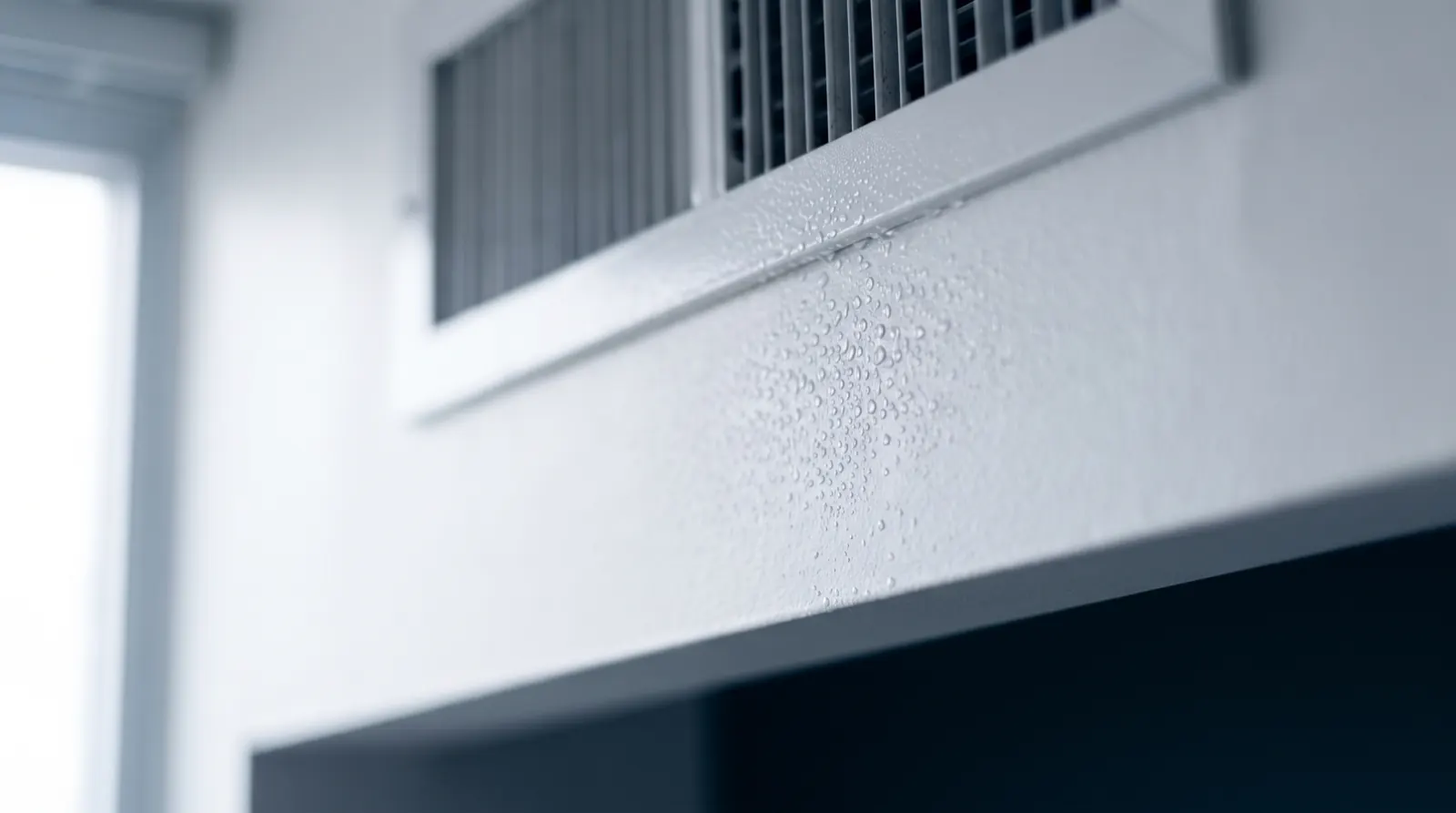
- The temperature at which moisture in the air condenses into liquid water. When a surface, like a cold AC vent or an uninsulated duct, sits below the dew point of the air around it, condensation forms on it, and repeated condensation can feed mold.
Inspection & testing
- Mold inspection
- Also called: mold check, mold survey, mold detection, home mold inspection
- An investigation of a property for mold and the moisture behind it: building history, a visual assessment, moisture and humidity readings, thermal imaging, and sampling when it answers a real question. The result is a written report with findings and next steps.
- Learn more
- Mold assessment
- Florida's legal term for the licensed inspection work: "a process performed by a mold assessor that includes the physical sampling and detailed evaluation of data obtained from a building history and inspection to formulate an initial hypothesis about the origin, identity, location, and extent of amplification of mold growth of greater than 10 square feet" (§ 468.8411).
- Learn more
- Mold assessor
- Also called: mold inspector, licensed mold inspector
- Florida's licensed title for "any person who performs or directly supervises a mold assessment" (§ 468.8411). Florida mold assessor license numbers begin with MRSA; Sterling's is MRSA5798.
- Learn more
- Mold testing
- Also called: mold test, mold sampling, mold tester, spore testing
- Collecting air, surface, or bulk samples for laboratory analysis. Testing answers specific questions, such as what is growing or whether the air inside differs from outside. It isn't the same as an inspection, which finds where the moisture and growth are.
- Learn more
- Air sample (spore trap)
- Also called: air quality test, mold air test, spore trap sample, air sampling
- A measured volume of air pulled through a sampling cassette that captures airborne particles, which a lab then counts and identifies. Indoor results are read against an outdoor sample taken at the same visit.
- Learn more
- Outdoor baseline
- Also called: control sample, outdoor control, reference sample
- An air sample taken outside at the same visit as the indoor samples. Spores are always in outdoor air, so indoor counts are judged by comparing them with the outdoor sample, not against a single fixed number.
- Surface sample
- Also called: tape lift, swab sample, bulk sample
- A sample taken directly from a surface with clear tape or a swab, or a small piece of the material itself, to identify what is growing there. It tells you what a spot is, not how much is in the air.
- Learn more
- Spore count
- Also called: spores per cubic meter, mold count, spore levels
- The number of spores of each type a lab finds in an air sample, usually reported per cubic meter of air. There are no federal limits for indoor mold spores, so counts are read against the outdoor baseline and the types found.
- Learn more
- Accredited laboratory
- Also called: mold lab, third-party lab
- An independent laboratory accredited to analyze environmental samples. Sterling's samples go to Daane Labs, a third-party lab, so the company that collects a sample isn't the one grading it.
- Learn more
- Moisture meter
- Also called: pin meter, pinless meter
- A handheld instrument that reads the moisture in drywall, wood, and other materials, with pins or a non-invasive pad. Readings mean the most when compared with the same material in a known-dry part of the building.
- Thermal imaging
- Also called: infrared camera, infrared scan, IR camera, thermography
- A camera that shows surface temperature differences. Wet materials often read cooler, so it helps find moisture behind walls and ceilings. It detects temperature, not water or mold, so every cool spot is confirmed with a moisture meter.
- Hygrometer
- Also called: thermo-hygrometer, humidity meter
- An instrument that measures relative humidity and temperature, used to check indoor humidity, compare rooms, and work out the dew point.
- Learn more
- Moisture mapping
- Also called: moisture map, moisture survey, moisture investigation
- Taking and recording moisture readings across an area to find the edges of the wet zone and trace it back to its source.
- Learn more
- Indoor air quality (IAQ)
- Also called: air quality testing, IAQ test, home air quality
- The condition of the air inside a building, including humidity, particulates, and airborne mold. An indoor air quality evaluation looks at the whole picture, not only mold.
- Learn more
- Remediation protocol
- Also called: mold protocol, mold remediation protocol, scope of work
- A written plan, usually from a licensed assessor, that tells a remediator what to remove, how to contain the work, and what the area has to pass at clearance.
- Learn more
- Post-remediation verification (PRV)
- Also called: clearance testing, clearance test, mold clearance, post-remediation testing, PRV
- Independent testing after remediation to confirm the work area is clean, dry, and ready for containment to come down. In Florida, the company that remediated a structure can't assess it within 12 months, so clearance comes from someone else (§ 468.8419(2)(d)).
- Learn more
Mold remediation
- Mold remediation
- Also called: mold removal, mold abatement, mold cleanup, mold mitigation, mold treatment
- Removing mold growth and the materials it damaged under controlled conditions, then cleaning and drying what remains. Florida defines it as "the removal, cleaning, sanitizing, demolition, or other treatment, including preventive activities, of mold or mold-contaminated matter of greater than 10 square feet that was not purposely grown at that location" (§ 468.8411).
- Learn more
- Mold remediator
- Also called: mold remediation company, mold removal company, remediation specialist
- Florida's licensed title for "any person who performs mold remediation" (§ 468.8411). Florida mold remediator license numbers begin with MRSR; Sterling's is MRSR5761.
- Learn more
- Containment
- Also called: mold containment, poly containment, critical barrier
- Plastic sheeting that seals the work area off from the rest of the building, with openings sealed and a zippered entry, so spores and debris disturbed during the work stay inside it.
- Negative air pressure
- Also called: negative air, negative air machine, NAM
- Running a HEPA-filtered air scrubber that exhausts air out of the contained work area, so any air leak flows into containment rather than out into the rest of the house.
- HEPA
- Also called: high-efficiency particulate air, HEPA filter
- High-efficiency particulate air: a filter standard that captures at least 99.97 percent of particles 0.3 microns in size. HEPA air scrubbers and HEPA vacuums keep spores from being blown or swept back into the air.
- Learn more
- Air scrubber
- Also called: HEPA air scrubber, air filtration device, AFD
- A portable fan unit that pulls air through a HEPA filter. In remediation it cleans the air inside containment and, when ducted out of the work area, creates negative pressure.
- HEPA vacuuming
- Also called: HEPA vac
- Vacuuming with a HEPA-filtered vacuum, so settled spores and debris are captured instead of being exhausted back into the room the way an ordinary vacuum can.
- Learn more
- Damp wiping
- Also called: damp wipe, wipe-down
- Wiping hard surfaces with a damp cloth and cleaning solution to lift the settled spores and fine debris that remain after HEPA vacuuming.
- Source removal
- Also called: tear-out, demo, removal of affected materials
- Cutting out and bagging porous materials that mold has grown into, such as drywall, insulation, carpet, and pad. Growth inside porous materials can't be reliably cleaned out, so those materials come out.
- Porous vs. non-porous materials
- Also called: porous materials, semi-porous materials
- Porous materials (drywall, ceiling tile, insulation, carpet) soak up water and let mold grow into them, so they're usually removed. Non-porous materials (metal, glass, hard plastic) and many semi-porous ones (framing lumber) can usually be cleaned.
- Antimicrobial
- Also called: biocide, fungicide, mold killer, antimicrobial spray
- A product applied to suppress microbial growth. It can support cleaning, but it doesn't remove mold growth or its residue, so it's never a substitute for removal and cleaning.
- Encapsulant
- Also called: mold-resistant coating, mold sealer
- A coating applied after cleaning, often to framing or roof sheathing, to seal in remaining staining and resist future growth. Applied over active growth or a wet material, it hides the problem instead of fixing it.
- Fogging
- Also called: mold fogging, dry fog, ULV fogging, mold bombing
- Dispersing an antimicrobial as a fine mist throughout a space. Fogging doesn't remove mold growth or the moisture behind it, so Sterling uses it only as a supplemental step after removal and cleaning.
- Learn more
- Personal protective equipment (PPE)
- Also called: respirator, Tyvek suit
- The respirators, disposable coveralls, gloves, and eye protection worn inside containment during mold remediation and Category 3 water cleanup.
- Clearance criteria
- Also called: passing clearance, clearance standards
- The conditions a work area must meet before containment comes down: typically no visible mold or debris, dry materials, and sample results consistent with the outdoor or reference samples.
- Learn more
Water damage & drying
- Water mitigation
- Also called: water damage mitigation, emergency water removal, emergency water mitigation
- The emergency phase after a water loss: stopping further damage by extracting water, removing what can't be saved, and drying the structure. Repairs and rebuilding come after, as a separate phase.
- Learn more
- Water damage restoration
- Also called: water restoration, water damage repair, water damage cleanup
- The broad term for getting a property back after water damage: mitigation (extraction, removal, and drying) followed by repairs. Sterling does the mitigation and cleanup; structural repairs and rebuild are separate work.
- Learn more
- Water extraction
- Also called: water removal, water pump out, flood clean up
- Removing standing water from floors, carpet, and pad with pumps and extraction equipment. It's the fastest way to get water out of a building; drying handles the moisture left inside materials.
- Learn more
- Structural drying
- Also called: dry out, drying out a house, water damage drying
- Drying the building materials themselves (drywall, framing, subfloor, and cabinets), not just the air, with dehumidifiers and air movers placed for the rooms and materials involved, and checked with daily moisture readings.
- Learn more
- Dehumidifier (LGR)
- Also called: LGR dehumidifier, commercial dehumidifier, desiccant dehumidifier
- A machine that removes moisture from the air. Restoration-grade low-grain refrigerant (LGR) units keep pulling water out as the air gets drier, which is what lets wet materials give up their moisture.
- Air mover
- Also called: drying fan, carpet fan, blower
- A high-velocity fan aimed across wet surfaces to speed evaporation. Air movers and dehumidifiers work as a pair: the air mover lifts moisture into the air, and the dehumidifier takes it out.
- Category 1 water
- Also called: clean water
- Under the IICRC S500 standard, water from a sanitary source, such as a broken supply line or an overflowing sink, that poses no substantial risk if it's handled quickly. Left standing, it can degrade to Category 2 or 3.
- Category 2 water
- Also called: gray water, grey water
- Under the IICRC S500 standard, water with significant contamination that could cause illness if contacted or swallowed, such as washing machine or dishwasher discharge, or a toilet overflow with urine but no feces.
- Category 3 water
- Also called: black water, sewage, grossly contaminated water
- Under the IICRC S500 standard, grossly contaminated water that can carry pathogens: sewage, toilet backflow from beyond the trap, and flooding from rivers, seawater, or storm surge. Porous materials it soaks are removed, not dried.
- Learn more
- Classes of water damage
- Also called: Class 1, Class 2, Class 3, Class 4
- The IICRC S500 scale for how much water the materials absorbed and how hard the space will be to dry, from Class 1 (little water absorbed) to Class 4 (specialty drying for dense materials like hardwood, plaster, and concrete).
- Burst pipe
- Also called: busted pipe, pipe burst, broken pipe, supply line leak
- A pressurized water line that splits, separates, or fails at a fitting and keeps releasing water until the supply is shut off. It starts as Category 1 (clean) water, but because the water keeps running, it can soak far more drywall, flooring, and cabinetry than it looks like from the doorway.
- Learn more
- Sewage backup
- Also called: sewer backup, sewer back up, sewage back up, septic backup
- Wastewater coming back up through toilets, tubs, or floor drains because of a blockage or failure in the sewer or septic line. It's Category 3 water, so it's cleaned up with containment and protective equipment.
- Learn more
- Flood cut
- Also called: flood cutting, drywall cut
- Cutting drywall in a straight line above the wet or contaminated line, often 2 or 4 feet up the wall, so that section can be removed and the wall cavity can dry.
- Dry standard
- Also called: drying goal, dry reference
- The moisture reading of the same material in an unaffected part of the building. Drying is finished when the wet materials reach that reading, not when they feel dry to the touch.
- Wicking
- Also called: capillary action
- Water moving up and through porous materials, like drywall drawing water up from a wet floor. It's why drywall can be wet well above the visible waterline.
- Contents pack-out
- Also called: pack out, contents removal, contents cleaning
- Inventorying, packing, and moving belongings out of the affected area so the structure can be dried or remediated, and so the contents can be cleaned or dried separately.
- Learn more
Building, AC & HVAC
- Drywall
- Also called: sheetrock, sheet rock, gypsum board, wallboard
- Gypsum panels faced with paper that make up most interior walls and ceilings. The paper facing feeds mold when it stays wet, which is why wet drywall is dried fast or cut out.
- Baseboard
- Also called: base trim, base molding
- The trim along the bottom of a wall. Pulling baseboards lets technicians check and dry the bottom of the wall, where water collects first.
- Subfloor
- Also called: slab, floor deck
- The structural layer under finished flooring: plywood or OSB over wood framing, or, in many Florida homes, the concrete slab itself.
- Learn more
- Roof sheathing
- Also called: roof decking, attic decking, roof deck
- The plywood or OSB panels under the roofing, visible from inside the attic. It's where attic mold usually grows, fed by roof leaks, poor attic ventilation, or bathroom fans venting into the attic.
- Learn more
- Air handler
- Also called: AHU, air handling unit, indoor AC unit, fan coil
- The indoor part of a central AC system, holding the blower, the evaporator coil, and the drain pan. It's cool and wet whenever the system runs, which makes it a common place for mold to grow in Florida homes.
- Learn more
- Evaporator coil
- Also called: AC coil, indoor coil
- The coil inside the air handler that cools the air and pulls moisture out of it. The water that condenses on it drips into the drain pan.
- Drain pan
- Also called: condensate pan, AC pan
- The pan under the evaporator coil that collects condensate. A pan that holds standing water, or one that rusts through, is a common source of water damage and mold in the AC closet.
- Condensate drain line
- Also called: AC drain line, condensate line, AC drain
- The pipe that carries the water your AC removes from the air out of the house. When it clogs, the drain pan can overflow into the air handler closet, the ceiling below, or the walls.
- Learn more
- Ductwork
- Also called: air ducts, flex duct, duct board
- The ducts that carry air from the air handler to the rooms. Florida homes often use flexible duct or fiberglass duct board; the EPA advises that insulated ducts that get wet or moldy can't be effectively cleaned and should be replaced.
- Learn more
- Supply vent
- Also called: AC vent, air vent, register, diffuser
- The grilles where conditioned air enters a room. Dark spots on and around them can be condensation-fed growth or ordinary dust, and a closer look, or a sample, tells which.
- Learn more
Florida law & standards
- DBPR
- Also called: Florida Department of Business and Professional Regulation, myfloridalicense
- The Florida Department of Business and Professional Regulation, which licenses mold assessors and mold remediators. Anyone can check a license at myfloridalicense.com.
- Learn more
- Chapter 468, Part XVI
- Also called: Florida mold law, mold-related services law
- The part of the Florida Statutes that governs mold-related services: the definitions, licensing of assessors and remediators, and the conflict-of-interest rules.
- Learn more
- 12-month rule
- Also called: conflict-of-interest rule, assessor-remediator rule
- Florida's conflict-of-interest rule: a mold assessor can't remediate a structure it assessed within the last 12 months (§ 468.8419(1)(d)), and a remediator can't assess a structure it remediated within 12 months (§ 468.8419(2)(d)).
- Learn more
- 10-square-foot threshold
- Also called: 10 sq ft rule
- Florida's definitions of mold assessment and mold remediation both refer to mold growth "of greater than 10 square feet" (§ 468.8411).
- Learn more
- IICRC
- Also called: Institute of Inspection, Cleaning and Restoration Certification
- The Institute of Inspection, Cleaning and Restoration Certification, which develops the industry's cleaning and restoration standards and certifies technicians.
- IICRC S520
- Also called: ANSI/IICRC S520, S520 standard
- The ANSI/IICRC S520 Standard for Professional Mold Remediation, the industry reference for how mold remediation is planned and carried out. Sterling's remediation follows it.
- Learn more
- IICRC S500
- Also called: ANSI/IICRC S500, S500 standard
- The ANSI/IICRC S500 Standard for Professional Water Damage Restoration, which defines the categories and classes of water damage and how drying is done. Sterling's water work follows it.
- Learn more
- WRT
- Also called: Water Damage Restoration Technician, IICRC WRT
- Water Damage Restoration Technician, an IICRC certification covering water damage mitigation and drying. Sterling's owner holds it.
- NORMI
- Also called: National Organization of Remediators and Mold Inspectors
- The National Organization of Remediators and Mold Inspectors, which trains and certifies mold assessors and remediators. Certification is separate from Florida licensing, which only the state issues.

Ask about what you're seeing.
Tell us what you're dealing with and we'll tell you whether it calls for an inspection, remediation, or drying. Quote back in about one business hour.