You should consider mold testing without visible mold when there is a persistent musty odor, when someone in the home has symptoms a physician associates with damp environments, when there has been a leak or flood whose repair you cannot verify, or when indoor humidity stays above sixty percent. If none of those are present and the house is dry and odorless, testing is usually not worth the money, and a moisture inspection is the better first step in every one of those cases anyway.
The question behind the question is almost always "is something hidden in my house?" It is a fair worry in coastal Florida, where growth inside a wall cavity, under a floor, behind a shower, or inside the air handler is common and invisible from the living room. But the tool for finding hidden moisture is not a laboratory. It is an inspection with instruments, and testing is the layer that gets added when the inspection cannot see far enough or when a document is needed. This note walks through when each applies, drawing on what we find in homes from Vero Beach to Boca Raton where the client called because of a feeling rather than a stain.
What are the signs that hidden mold might be present?
The signs that most reliably turn into a real finding are an odor, a health pattern that tracks with the house, a moisture history, and a humidity number, roughly in that order of reliability.
The odor is the strongest. Active growth releases compounds as it feeds, and those compounds produce the musty, earthy, wet cardboard smell that people describe. The smell does not depend on the growth being somewhere you can see. It is strongest in closed spaces with little airflow, so the way to find it is to close a closet or a bathroom for a few minutes and then open the door and breathe in immediately. It is often strongest first thing in the morning or when you return after a day away, because a nose adapts to a smell it lives with. It frequently tracks with the air conditioning cycling on, which points toward the air handler or the ducts. Our note on tracking a musty smell with no visible mold describes the investigation in detail.
The health pattern is the second. When someone in the household feels worse at home and better away, worse in one room than another, or worse since a particular event, that pattern is information even though an assessor is not a medical provider and cannot diagnose anything. The symptoms commonly associated with damp indoor environments are respiratory and allergic in nature, and the right move is a physician for the person and an inspection for the house, in parallel. Our note on what indoor humidity should be in coastal Florida explains why the air itself is so often the cause behind those patterns.
The moisture history is the third. A roof leak that was repaired, a supply line that burst, a storm that pushed water under a door, a condensate line that overflowed, a previous remediation. Any of those means water was in the building, and the question is whether the materials it touched actually dried before they were closed up. In our experience they frequently did not, because the visible finish was replaced and the framing behind it was left to dry on its own in a house that runs at sixty percent humidity.
The humidity number is the fourth and the most overlooked. A cheap hygrometer placed in a bedroom, the living area, and near the air handler return will tell you in a week whether the house is running above sixty percent for long stretches. If it is, growth on cool surfaces and on dust is likely somewhere regardless of any leak, and the closets on exterior walls, the garage, and the inside of the air handler are the usual places. Our note on what indoor humidity should be in coastal Florida explains the targets and how to hold them.
Why is a moisture inspection the right first step, not testing?
Because testing tells you what is in the air at one moment, and an inspection tells you where the water is, and the water is the thing that gets fixed.
An inspector arriving at a house with no visible growth and a musty smell does not start with a pump. The visit begins with the intake, then indoor and outdoor humidity and temperature, then a thermal camera pass across every wall and ceiling in the house looking for the cool signatures of evaporating moisture, then a moisture meter on anything the camera flagged and on the usual suspects regardless. The usual suspects in a Florida home are the base of every exterior wall, every window perimeter, under every sink, the walls behind showers, the laundry, the water heater, the closets on exterior walls, and the air handler closet with its drain line. The attic gets entered where it can be, because sweating ducts and bathroom fans terminating in the insulation are two of the most common sources of a smell nobody can locate. A borescope goes into cavities through existing openings where there is reason to look.
That process finds the source in a large share of the cases we see. A slow drip behind a dishwasher. A window that leaks only in wind driven rain. A condensate pan with a clogged primary drain that has been overflowing a little every afternoon. Ductwork dumping cold air onto a ceiling and condensing. When the source is found, the smell is explained and the recommendation is a fix, and testing at that point usually adds a number to a conclusion already reached.
When the inspection cannot locate a source, that is when air sampling earns its place, because the question has changed from "where is the water" to "is this house amplifying something internally, and in which zone."
When is air sampling worth it with no visible mold?
Air sampling is worth it when the inspection has not found the source of a persistent odor, when a physician or a third party needs a documented result, when a moisture history cannot be verified without opening finishes and you want a data point before doing that, or when a household member is sensitive and you need to know what the air contains.
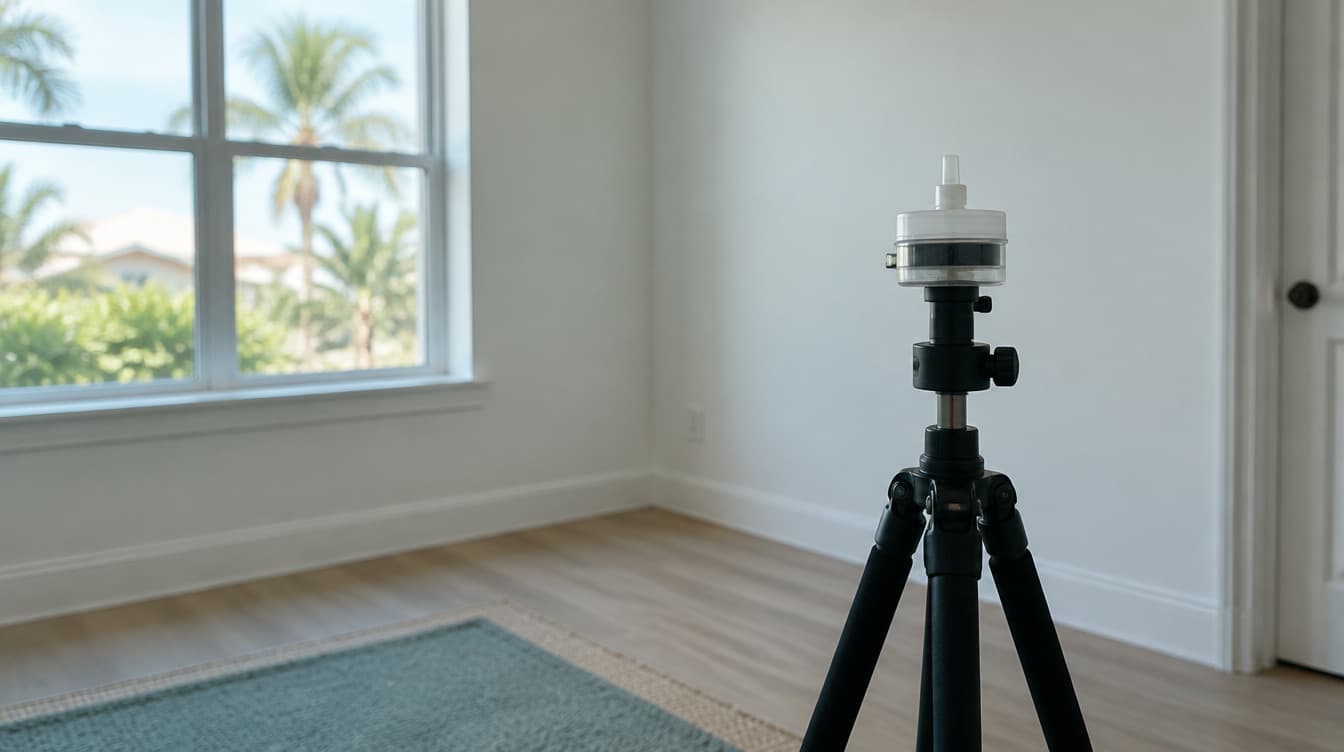
The method is a spore trap. A calibrated pump pulls a known volume of air, typically about a hundred and fifty liters over about five minutes, through a cassette that captures airborne particles on a sticky surface. An accredited laboratory reads the whole trace under a microscope, identifies spore types, and reports counts per cubic meter of air. An outdoor control sample taken the same day at the property is what makes the indoor number mean anything, because outdoor spore levels on the Treasure Coast swing enormously with the season, the weather, and recent rain. The comparison is the result. Indoor air that looks like the outdoor air, dominated by the same common outdoor types at similar or lower levels, is normal. Indoor air that contains types the lab associates with water damaged buildings, or a type at a much higher level than outdoors, points to an indoor source. One indoor sample per air handler zone is the usual minimum for a whole house question, and our answer on what air quality testing for mold actually is covers the method.
It has real limits and an honest assessor names them before the pump runs. The sample is a few minutes in one spot. It cannot tell live spores from dead ones. It does not measure the compounds that cause the odor. It can miss growth sealed inside a wall that is not releasing spores into the room right then. A not elevated result in a house with a moisture history is a favorable data point, not proof that the wall is clean. Our note on how to read your mold lab report covers the interpretation.
Air sampling is not worth it when the inspection already found the source and the fix is clear, when there is no odor, no symptoms, no history, and normal humidity, or when the only purpose is reassurance and the inspection has already provided it in writing. We turn down sampling in those cases and the report says why, which is what independence is for.
What about the situation where you cannot verify a past repair?
This one deserves its own answer because it is so common in home purchases and in rentals. The seller or the landlord says the leak was fixed. The drywall is new and painted. Nothing is visible. Nothing smells, or maybe something faintly does. You want to know whether the cavity behind the new drywall was dried before it was closed.
The inspection is the first step, as always. A moisture meter on the repaired area and the materials around it, a thermal pass, a borescope through an outlet opening or a small existing gap if there is one. If the readings are dry and the cavity looks clean, that is a good answer. If the readings are elevated or the borescope shows staining on the framing, that is a finding, and the next step is either opening the wall or sampling to establish what is there before deciding.
Testing fits in two ways here. An air sample in that room against the outdoor control can indicate whether the repaired area is releasing anything, with the caveat that a sealed cavity may not. And if the wall is opened, a surface sample of what is found documents it for the negotiation or the notice. For a buyer, that documentation is what turns "I think something was covered up" into a specific request to the seller. Our note on buying a home with possible microbial growth on the inspection report covers the transaction side.
What can you do yourself before calling anyone?
A few things, and they are worth doing because they either answer the question or make the inspection sharper.
Put hygrometers in a bedroom, the living area, and near the air handler return, and log the readings morning and evening for a week. Check the thermostat fan setting and make sure it is on auto rather than on, because a fan running continuously re-evaporates the water the coil just removed and pushes humidity back into the house. Do the closed door smell test on every closet, bathroom, and the air handler closet. Pull everything out from under every sink and look at the cabinet floor. Move the clothes in the closets on exterior walls and look at the wall behind them. Look at the supply registers for dark dusting and at the return grille. If you can safely open the attic hatch, look and smell without climbing in. Write down what you find and when the smell is strongest.
If that turns up growth, a wet cabinet floor, or a specific smell location, you have moved from "should I test" to "I have a finding," and the inspection will start there. If it turns up nothing and the humidity log is fine, you have a reasonable basis to stop worrying. If the humidity log is high and nothing is visible, the problem is the air, not a leak, and the fix is a conversation about the air conditioner and dehumidification rather than a lab. Our note on why AC oversizing makes Florida homes humid is where that conversation starts.
Do not fog, spray, or bleach anything you find before it is documented. It does not fix the cause, and it destroys the evidence.
What to do next
If you have an odor, a health pattern, a moisture history, or a high humidity reading, book an inspection and describe those specifics when you do. Say where the smell is strongest and when. Say what the physician has said. Say what leaked and when and who repaired it. Say what the hygrometer reads. Those details tell an assessor where to look hardest and whether sampling is likely to be warranted before the visit is even scheduled.
Sterling's assessor has personally completed more than three hundred inspections since January 2026 across the Treasure Coast and Palm Beach County, and a large share of them began with a client who could not see anything but knew something was wrong. On many of those, the inspection found the source and no sampling was needed. On some, air sampling was the tool that pointed to the zone. The report says which, and why. The process page shows the visit, the pricing page shows how sampling is priced separately from the inspection, and you can request a quote and tell us what you are noticing. If Sterling inspects your home, Florida law bars us from remediating it for twelve months, and we take no referral fees, so the answer to "should I test" is allowed to be no.
Frequently asked questions
Should I get mold testing if I don't see any mold?
Consider it when there is a persistent musty odor, when someone in the home has symptoms a physician associates with damp environments, when a past leak or flood repair cannot be verified, or when indoor humidity stays above sixty percent. In every one of those cases a moisture inspection with a meter and thermal imaging is the right first step, because it locates the source, and air sampling is added when the inspection cannot find one or when a documented result is needed.
Can there be mold in a house without any visible signs?
Yes. Growth inside wall cavities, under flooring, behind shower walls, inside the air handler, in ductwork, and in attics is common in Florida homes and is not visible from the living space. The usual signs are a musty odor that is strongest in closed spaces, elevated indoor humidity, a history of leaks, and sometimes symptoms in occupants. An inspection with a moisture meter, thermal imaging, and a borescope is how hidden growth is located, and air sampling compared against an outdoor control is how an indoor source is confirmed when nothing can be seen.
Is an air quality test for mold worth it?
It is worth it when it answers a question the inspection cannot, such as whether a house with a persistent odor and no located source is amplifying mold internally, or when a physician, landlord, buyer, or insurer needs a laboratory result. It is not worth it when the inspection has already found the moisture source and the fix is clear, or when there is no odor, no symptoms, no history, and normal humidity. An independent assessor will say which applies before running the pump.