A mold inspector looks for water and for the conditions that let water linger: active and historical moisture in building materials, humidity in the air, the places where warm damp air meets cool surfaces with no airflow, the systems that handle water and can fail, the visual signatures of past wetting, and the odor that active growth produces. Visible mold is one data point among many. The inspection is the search for what caused it and what else it has touched.
People often expect an inspector to walk in, look at the spot they called about, and pronounce on it. What actually happens is closer to a detective walking a house looking for how water moves through it, with the spot you called about serving as the first clue. This note is a tour of that process, organized the way we actually move through a home on the Treasure Coast or in Palm Beach County, and it explains what each observation means and why it gets attention. It complements our overview of what a mold inspection includes in Florida by going into the reasoning behind each look.
What does a mold inspector look for before entering the house?
The inspector looks at how water is managed on the outside of the building, because a large share of interior moisture problems begin at the roof edge, the grading, or the wall surface.
The walk around the exterior starts with the roof edges and the gutters, if there are any. Downspouts that discharge at the foundation rather than a few feet away saturate the soil against the slab and the block, and in a slab home that water wicks up into the base of the interior walls. Grading that slopes toward the house does the same. The stucco or siding at ground level gets a look for cracking, staining, and efflorescence, which is the white mineral crust water leaves as it moves through masonry. Window and door perimeters get a look for failed caulk, gaps at the sill, and staining below, because wind driven rain finds those openings every summer, and our note on wind driven rain and stucco walls describes exactly how that water gets in. Hose bibs, the condensate discharge line, and the dryer vent termination get a look for drips and for whether they are actually terminating where they should. The exterior air conditioning unit's location and the condensate line where it exits the wall tell part of the air handler story before the closet is opened.
Outdoor temperature and humidity get recorded here, because the indoor reading only means something in comparison.
What does a mold inspector look for in each room?
In every room the inspector looks for the same things in the same places: the perimeter where the wall meets the floor, the perimeter of every window and door, the ceiling, the corners, the condition of paint and trim, and the temperature pattern across every surface.
The base of every exterior wall gets a moisture meter reading, not just the ones with visible staining, because wicking from the slab and intrusion at the wall base show up as elevated readings in the bottom foot of drywall long before anything is visible. A thermal camera pass across every wall and ceiling comes first in each room, since it scans the entire surface in seconds for the cool patterns that evaporating moisture produces. A cool patch with no obvious explanation, such as a duct behind it, gets a meter reading. A cool band along the bottom of a wall gets a meter reading. A cool spot on a ceiling below a bathroom gets a meter reading. The camera finds candidates. The meter confirms them.
Paint gets read as a record. Bubbling and peeling mean moisture pushing through from behind. Chalking means a surface that has been damp for a long time. A single wall or patch that is fresher than the rest of the room means someone addressed a stain, and the meter goes there next. Baseboards and trim get a look for swelling, separation from the wall, and dark lines along the bottom edge. Flooring gets a look for cupping, buckling, soft spots, and lifted seams. Window sills get a look for staining and softness, and window tracks get a look for the film that comes back after cleaning.
Corners get particular attention, both the corners where two exterior walls meet, which are the coldest spots in the room, and the top corners where the wall meets the ceiling, where warm humid air pools. Closets on exterior walls are inspected with the clothes pulled aside, because they are the single most common location of humidity driven growth in Florida homes, and the growth is on the wall behind the hanging items.
Each room's supply register gets a look for dark dusting around the grille and for condensation, and the return grille gets a look for the same. Any odor in a closed room gets noted and located.
What does a mold inspector look for in the kitchen, bathrooms, and laundry?
The places where water is piped, used, and drained, because a slow leak at any of those connections is one of the most common sources of concealed growth.
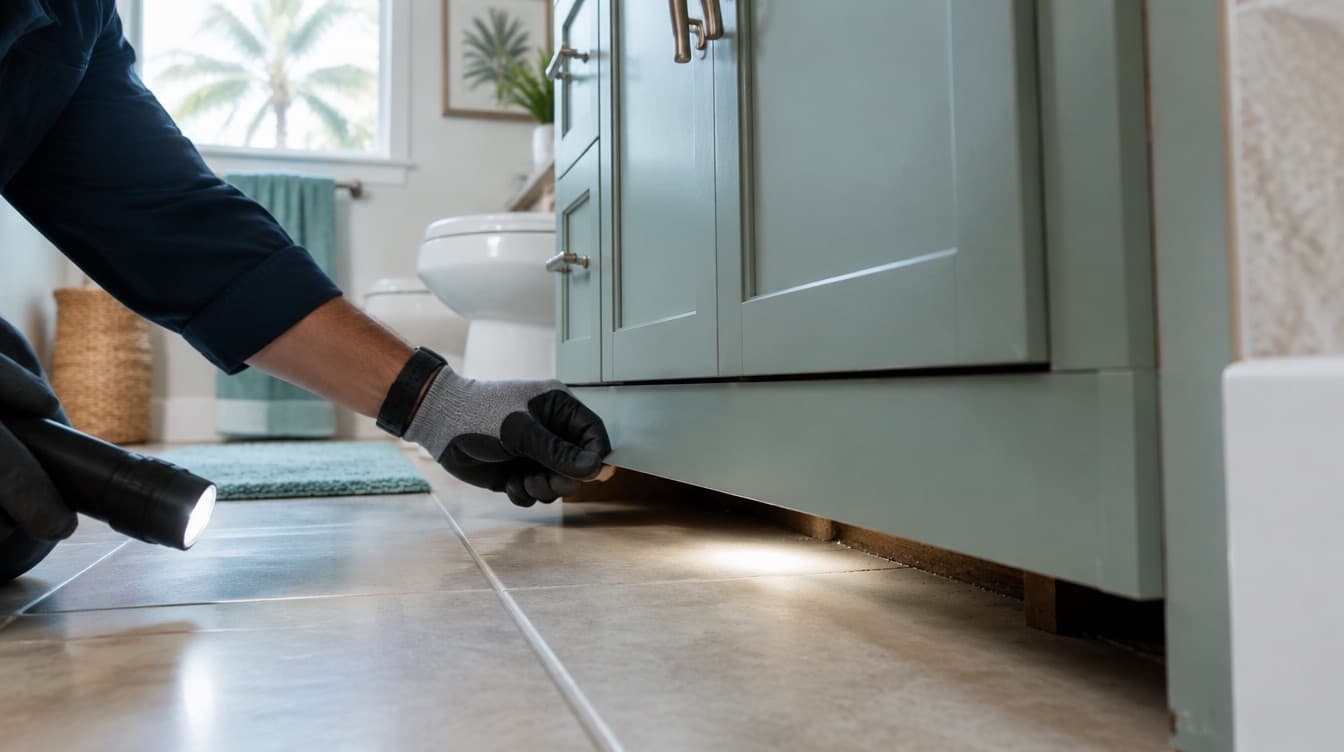
Under every sink, the cabinet floor and the back wall get a look and a meter reading, and the supply lines, the shutoff valves, the drain trap, and the dishwasher connection get felt for dampness. White fuzz on a cabinet floor, a swollen or delaminating cabinet bottom, and a dark ring around the drain penetration are the usual signs. The dishwasher gets a look at the floor in front of it and, where possible, beneath the toe kick. The refrigerator's ice maker line and the floor beneath and behind the unit get a look. The hidden moisture signs guide covers that pattern in more detail.
In bathrooms, the ceiling above the shower gets a look for the haze of specks that follows rising steam, and the exhaust fan gets tested for airflow with a square of tissue against the grille. The wall behind the shower and the wall shared with an adjacent room get a thermal pass and a meter reading, because a failed shower pan or a leaking valve wets the cavity behind the tile without showing on the tile itself. The base of the toilet, the wall behind it, and the floor around it get a reading. The vanity gets the same treatment as a kitchen sink. Caulk and grout get a look for separation, since water behind a separated caulk line is a leak that never shows on the surface. Our note on bathroom exhaust fans explains why the fan test matters so much in this climate.
In the laundry, the floor and wall behind the washer get a look for staining and a meter reading, the supply hoses get a look for age and weeping, the drain standpipe gets a look for overflow signs, and the dryer vent gets traced to confirm it terminates outside rather than in the wall or the attic. The water heater, wherever it lives, gets a look at its base, the pan beneath it if there is one, the relief valve discharge, and the floor and wall around it.
What does a mold inspector look for at the air handler?
The single most important location in a Florida home, because the air handler is the humidity control for the entire house and its condensate system is the most common source of moisture that has nothing to do with a leak.
The closet floor and the base of the cabinet get a look and a meter reading first, because a condensate pan that has been overflowing a little every afternoon leaves a stain ring and elevated readings on the floor and the wall behind the unit. The primary drain line gets traced from the unit to where it exits, and its trap and its cleanout get a look. The presence and function of a float switch, which shuts the system off when the pan fills, gets checked. Where a cabinet panel can be safely removed, the coil, the pan, and the blower housing get a look with a flashlight for biofilm, standing water, rust, and growth. The filter gets pulled and its condition and rating noted, since a filter that is too restrictive starves the system and one that is too loose lets dust through to the coil. The return plenum and the supply plenum where they connect to the cabinet get a look for gaps that pull unconditioned attic or garage air into the system, and the insulation on the ductwork visible from the closet gets a look for condensation.
The thermostat gets a look for the fan setting, because a fan set to run continuously rather than on auto re-evaporates the water the coil just removed and pushes humidity back into the house, and it is one of the most common findings in the apartments and condos we inspect. The system's cycling gets observed if the visit is long enough, since a system that satisfies the thermostat in a few minutes and shuts off is not running long enough to dehumidify, which our note on why AC oversizing makes Florida homes humid explains. Our note on condensate drain line failures covers why the closet next to the air handler grows mold first.
Indoor temperature and humidity get recorded at multiple points in the house, and the comparison to the outdoor reading and to the mid forties to mid fifties target is one of the most useful single numbers in the report.
What does a mold inspector look for in the attic?
Condensation on ductwork, bathroom and dryer vents that terminate inside the attic, roof leaks, blocked ventilation, and the condition of the sheathing, because the attic is where a large share of the findings in Florida homes actually live and where almost nobody looks.
Supply ducts carrying cold air through an attic that is well over a hundred degrees in summer sweat when their insulation is thin or damaged, and that condensation drips onto the ceiling drywall below and wets the insulation. The duct jackets get a look for beads of water, staining, and sagging where water has collected. The boots where ducts meet the ceiling registers get a look for gaps and for staining on the drywall around them. Bathroom exhaust fan ducts get traced from the fan housing to wherever they end, and the answer is frequently the insulation or a soffit vent rather than a roof cap. The dryer vent gets the same trace. The underside of the roof sheathing gets a look for staining, darkening, and streaking, especially around penetrations, valleys, and the roof edge. Soffit vents get a look for blockage by insulation, and the overall ventilation gets assessed. The insulation gets a look for matting and discoloration that mark where water has been. The top of the ceiling drywall, seen from above, sometimes shows the stain that has not yet appeared on the room side.
Where the attic cannot be safely entered, it gets viewed and smelled from the hatch and the report says so.
What does a mold inspector look for that most people miss?
Age. The inspector is constantly asking not just whether a surface is wet, but how long it has been wet, because that separates an active problem from a resolved one and it changes what the fix is.
Rust on fasteners, hinges, vent grille screws, and the metal parts of the air handler is a slow clock that says the air has been damp for a long time. A stain with a hard, dark, dry edge and a dry meter reading is history. A stain that is soft and reads wet is now. Growth that has spread across a surface in a gradient, denser at one end, points back toward the source. Efflorescence on block says water has moved through it repeatedly. A closet that smells but reads dry says the humidity has been high even though nothing has leaked. Layers of paint over a stain say the problem has recurred. The inspector reads all of that into a timeline, and the timeline is what tells a buyer whether the seller's repair worked, a tenant whether the condition predates the lease, and a homeowner whether the fix they made last year held. Our note on telling an old ceiling stain from an active leak is a worked example of that reading.
Everything found gets photographed with labels and arrows, every reading gets recorded with its location, and the whole picture becomes a written report with the moisture source, or the plan to find it, at the center and the recommendations ranked from fixing the source through verification. Sampling gets added only when a laboratory result will answer something the inspection could not.
Sterling's assessor has personally completed more than three hundred inspections since January 2026 across the Treasure Coast and Palm Beach County, and every one of them followed this tour. The process page walks through the visit, the sample report shows what the documentation looks like, and you can request a quote if you would like this done in your home. An inspection from Sterling never turns into a remediation pitch, because Florida law bars us from remediating a home for twelve months after we inspect it and we take no referral fees, so the only thing we are looking for is the water.
Frequently asked questions
What does a mold inspector look for during an inspection?
A mold inspector looks for active and historical moisture in building materials using a moisture meter and thermal imaging, for indoor humidity above the safe range, for the places where humid air meets cool surfaces without airflow such as closets on exterior walls, for failures in the systems that handle water including the air handler condensate line and bathroom exhaust fans, for the visual signs of past wetting such as staining and paint failure, and for the odor of active growth.
Where does a mold inspector check in a house?
The exterior grading, gutters, and wall surfaces, the base of every exterior wall, every window and door perimeter, under every sink, the walls behind showers, the laundry and water heater, the closets on exterior walls, the air handler closet including the drain line, pan, coil, and filter, the supply and return grilles, and the attic including ductwork, exhaust fan terminations, and roof sheathing. Indoor and outdoor humidity and temperature are recorded throughout.
Does a mold inspector look inside walls?
Not by opening them. A standard mold inspection is non invasive, so the inspector reads what is inside a wall using a moisture meter on the surface, thermal imaging for the cool signature of evaporating moisture, and a borescope through existing openings such as outlets or gaps where there is reason to look. When those readings indicate concealed moisture, the report recommends either sampling or a limited opening of the wall to confirm, with the client's consent.