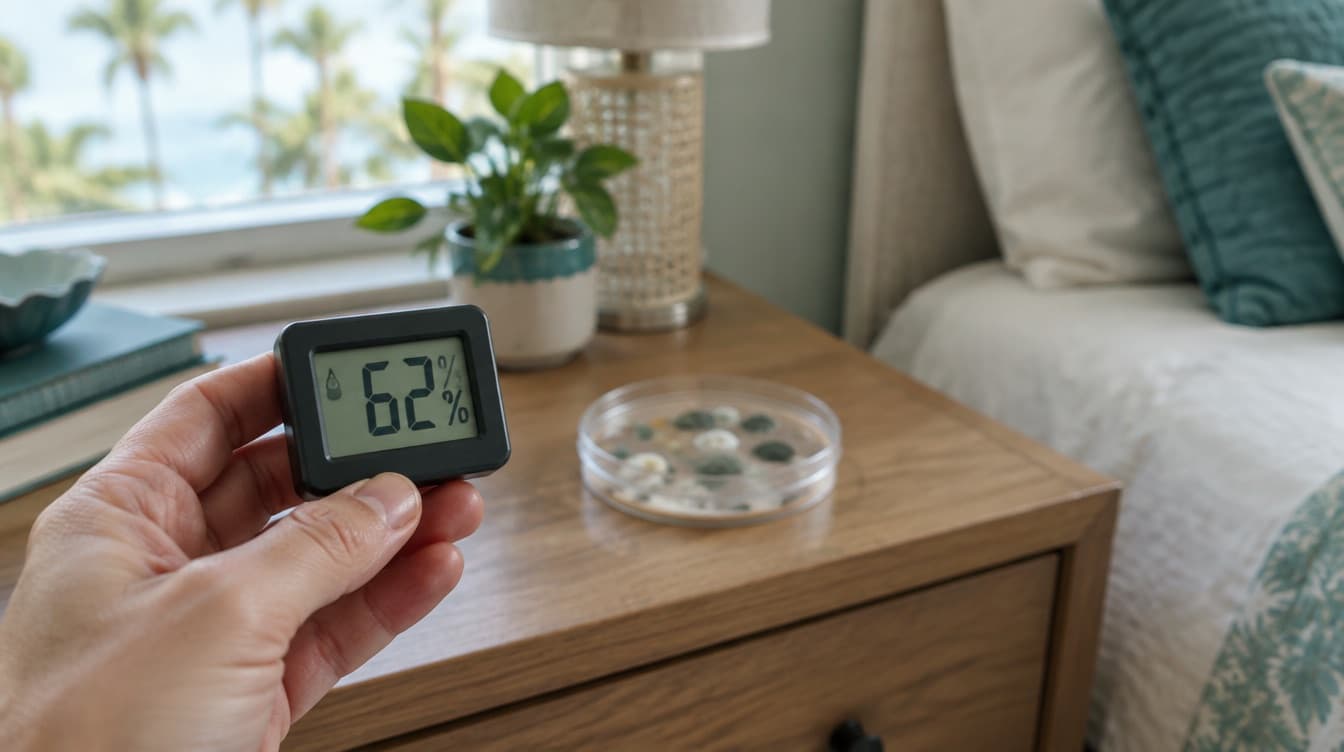
You can do a great deal of useful mold investigation yourself with a hygrometer, a flashlight, and your nose, and for a small visible problem with an obvious cause that is often all you need. What you cannot do yourself is reliably find hidden moisture, identify what a growth is with authority, produce a result a landlord or seller or insurer has to accept, or interpret an air sample against an outdoor baseline. Home test kits do not close that gap. A licensed assessor does.
That is the honest division of labor, and we hold to it because it is true and because an independent assessor has no reason to say otherwise. Some of the most useful conversations we have with homeowners across the Treasure Coast and Palm Beach County end with us telling them they do not need us. This note lays out what you can check on your own and how, why the kits sold for this purpose mislead, and the specific situations where the professional visit is the right call. It absorbs the question people ask about DIY kits versus professional testing, which our guide to DIY mold test kits versus a professional assessment covers from the kit side.
What can you check for mold yourself?
You can measure humidity, look in the places growth starts, follow your nose, read the paint and the trim, and inspect the systems that handle water. None of that requires a laboratory and all of it is genuinely diagnostic.
Start with humidity, because in coastal Florida it is the cause of more growth than any leak. Buy two or three inexpensive digital hygrometers and put one in a bedroom, one in the living area, and one near the return grille of the air handler. Read them morning and evening for a week and write the numbers down. The target for a Florida home is the mid forties to mid fifties percent. Readings that sit above sixty for long stretches mean growth on cool surfaces and on dust is likely somewhere in the house regardless of any leak, and the cause is the air conditioning and dehumidification rather than a plumbing problem. While you are at the thermostat, check the fan setting. If it says on rather than auto, switch it, because a continuously running fan re-evaporates the water the coil just removed and pushes humidity back into the house. Our note on what indoor humidity should be in coastal Florida explains the targets and the fixes.
Then look, with a strong flashlight, in the places growth starts. The closets on exterior walls, with the clothes pushed aside, especially the lower half of the wall and the corners. The backs of leather shoes and belts in those closets, which bloom first. Under every sink, with everything pulled out, at the cabinet floor and the back wall. The ceiling above every shower and the corner where the tub meets the wall. The wall and floor behind and beneath the washing machine. The floor of the air handler closet and the base of the cabinet. The supply registers and the return grille for dark dusting. The garage walls and anything stored on the slab. The attic hatch, opened and looked into without climbing in.
Then smell. Close each closet, bathroom, and the air handler closet for a few minutes, then open the door and breathe in immediately. Note where the musty smell is strongest and whether it is stronger in the morning or when the air conditioning cycles on. The smell is the most reliable sign of active growth there is, and it does not care whether the growth is visible.
Then read the surfaces. Bubbling, peeling, or chalky paint means moisture behind it. A single wall or patch painted more recently than the rest means someone addressed a stain. Swollen or separating baseboards, cupped or soft flooring, staining or softness on window sills, rust on vent grille screws, and a white mineral crust on block at the base of a wall are all water leaving a record. Our field guide to the signs of mold in your house goes through each of these.
Then check the systems. Hold a square of tissue against each bathroom exhaust fan grille while it runs and see whether the fan holds it. Look at where the condensate line leaves the air handler and whether there is a float switch. Look at the exterior grading and where the downspouts discharge. Feel the supply lines under the sinks for weeping. Our note on bathroom exhaust fans explains why the tissue test matters so much here.
If that whole pass turns up a small patch of growth with an obvious cause, a bathroom ceiling with a dead fan or a cabinet floor with a dripping trap, you have found your answer, and the fix is the fan or the trap followed by a cleaning.
Why do DIY mold test kits mislead?
Because every kind of kit sold to homeowners answers a question that does not help, or answers a useful question without the context that makes the answer usable.
Petri dish kits are the most common and the least useful. You open a dish of growth medium, leave it out for a period, seal it, and wait. Spores from the air land on the medium and grow into visible colonies. In coastal Florida, where outdoor air carries a heavy spore load every day of the year and every occupied home has that air in it, the dish will grow something in essentially every house. A positive result tells you that you live on Earth. Some kits offer to send the dish to a laboratory for identification, which will name common outdoor genera that are in your air because they are in everyone's air. There is no volume, no control, and no way to compare the result to anything.
Mail in swab or tape kits are a surface sample, which is a legitimate method, but stripped of what makes it useful. You have to decide where to swab, and if you swab the wrong thing or a surface that was cleaned, the result is meaningless. The sample travels without a chain of custody, so a landlord, a seller, or an insurer can reasonably decline to accept it as evidence of anything. And the result comes back without an inspection to interpret it, so a report naming a water damage indicator genus on your closet wall tells you nothing about why the closet is wet.
Passive air kits, where a dish or a plate is exposed to room air, have no calibrated pump and no measured volume, so the count cannot be converted to a concentration and cannot be compared to an outdoor sample. That comparison is the entire meaning of an air result.
The moisture detection gadgets sold alongside kits, the cheap pinless meters and the humidity indicator cards, are actually the most useful items in the category, because measuring moisture is the useful thing, and a homeowner with a decent pinless meter can learn a lot from reading the base of the exterior walls. What they cannot do is interpret the reading against a dry reference, or know which of the many things that make a pinless meter read high is present, which is where experience enters.
The result of all this is that a kit usually produces one of two outcomes. A positive that scares a homeowner into a remediation call they may not need, or a negative that reassures a homeowner about a wall that is wet. Both are worse than not testing.
When do you need a professional mold assessor?
When the moisture cannot be located, when the growth keeps returning, when someone in the home is affected, when the result has to persuade someone else, or when the outcome is expensive enough that being wrong matters.
The moisture cannot be located. You have done the pass above, there is a smell or a symptom or a stain, and you cannot find the water. This is the core of the professional's job. A moisture meter used with a dry reference, a thermal camera passed over every wall and ceiling, a borescope through an outlet opening, and the pattern recognition from hundreds of Florida houses find sources that a flashlight does not. Our note on tracking a musty smell with no visible mold describes that hunt.
The growth keeps returning. You cleaned it, it came back, you cleaned it again, it came back again. That is a moisture problem that has not been found, not a cleaning problem, and our note on why mold keeps coming back after cleaning explains why more cleaning will not change it.
Someone in the home is affected. When a household member has symptoms their physician associates with damp environments, the physician benefits from a documented air result with an outdoor control and an interpretation, and the identity of any growth matters more. An assessor is not a medical provider and will frame the finding carefully, but the documentation is what the physician can use.
The result has to persuade someone else. A tenant sending a notice to a landlord. A buyer negotiating with a seller. A homeowner documenting a claim for an insurer. A condo owner going to the association. In every one of those, a licensed assessor's report with photographs, moisture readings, and, where warranted, a laboratory result under chain of custody is the document the other party has to answer. A kit result and a phone photograph are not. We have watched one report change a landlord's answer from dismissal to a repair order, and that is the value of the professional visit in those situations.
The outcome is expensive. Before remediation is scoped, before a wall is opened, before a purchase closes, before a lease is broken. The inspection fee is the smallest number in any of those conversations, and it is the number that determines whether the larger ones are handled well.
Florida licenses mold assessors and mold remediators separately, and its statute prohibits an assessor from remediating a property they assessed within the previous twelve months and bans referral fees between the two, which the Florida mold law page quotes in full. That independence is what makes the professional's answer trustworthy, including when the answer is that you handled it fine yourself.
What a professional does that you cannot
Reads moisture against a reference, scans with thermal imaging, samples correctly, and interprets, and then writes it down in a form a third party has to take seriously.
The moisture meter reading you take at the base of a wall is a number. The same reading taken by an assessor is a number compared against the same material in a known dry location in the same house, adjusted for what the meter does on block versus drywall versus wood, and placed in the context of the humidity reading in the room and the thermal pattern on the wall. That context is the difference between "it reads high" and "the bottom eighteen inches of this west wall is wicking from the slab."
The thermal camera is the instrument a homeowner most often lacks, and it is the one that finds the second problem. An inspector passes it over every surface in the house in minutes, and the cool patch on the ceiling below the bathroom that nobody was worried about becomes the finding.
Sampling done professionally means the right method for the question, an outdoor control with every air sample, the air conditioning running normally, nothing disturbed beforehand, a chain of custody to an accredited laboratory, and a written interpretation of the result against what was observed in the house. Our note on the most accurate way to test for mold goes through why each of those steps matters.
And the report is written so that someone who was not in the house can act on it. Where the moisture is, whether it is active, why it is there, what the lab showed if sampling was done, and what to do next in order, from fixing the source through verification. Sterling's sample report shows what that looks like.
What to do next
Do the homeowner pass this weekend. Hygrometers in three rooms for a week. The flashlight tour of the closets, the sinks, the bathrooms, the laundry, the air handler closet, the garage, and the attic hatch. The closed door smell test. The tissue test on the bathroom fans. Write down what you find and where.
If that produces a small problem with an obvious cause, fix the cause, clean the surface, and watch it for a month. If it produces an elevated humidity log with nothing visible, the conversation is about the air conditioning, and our note on why AC oversizing makes Florida homes humid is where to start. If it produces a smell you cannot locate, growth that has already come back once, a household member who is affected, or a situation where someone else has to be persuaded, skip the kit and book the assessor, and bring your notes.
Sterling's assessor has personally completed more than three hundred inspections since January 2026 across the Treasure Coast and Palm Beach County, and a meaningful share of the calls we take end with advice rather than a booking. The process page shows what the visit looks like when it is warranted, the pricing page shows what it costs, and you can request a quote and describe what your own pass turned up. Florida law bars us from remediating a home for twelve months after we inspect it, and we take no referral fees, so if the honest answer is that you have already handled it, that is the answer you will get.
Frequently asked questions
Can I test for mold myself?
You can do a genuinely useful investigation yourself by logging indoor humidity with inexpensive hygrometers, inspecting closets on exterior walls, under sinks, bathrooms, the laundry, the air handler closet, and the garage with a flashlight, using the closed door smell test, reading paint and trim for moisture signs, and testing bathroom fans. What you cannot reliably do yourself is locate hidden moisture, identify growth with authority, or produce a result a third party has to accept.
Are DIY mold test kits worth it?
Generally no. Petri dish kits grow something in essentially every Florida home because outdoor spores are always in the air, so a positive result means nothing. Mail in swab kits lack the inspection that shows where to sample and the chain of custody that makes the result usable with a landlord or seller. Passive air kits have no measured volume and no outdoor control. The money is better spent on hygrometers and a decent flashlight, or on a licensed assessor when the situation calls for one.
When should I call a professional mold inspector instead of testing myself?
When you cannot locate the moisture source, when growth returns after cleaning, when someone in the home has symptoms a physician associates with damp environments, when the result has to persuade a landlord, seller, insurer, or association, or when an expensive decision such as remediation, opening a wall, closing on a purchase, or breaking a lease depends on the answer. A licensed independent assessor will also tell you plainly when you have already handled it yourself.