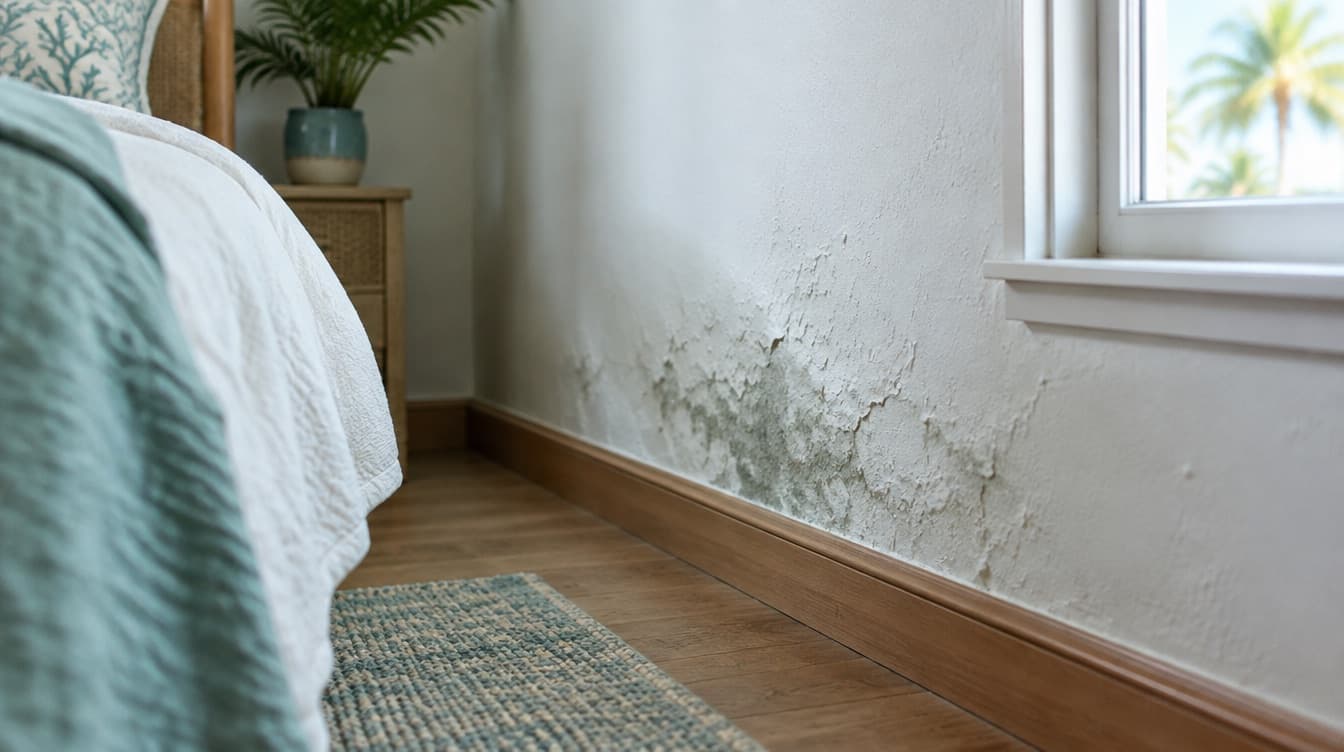
The signs of mold in a house are visible growth in spots, speckles, or fuzzy patches on walls, ceilings, grout, or contents, a persistent musty or earthy odor that is strongest in closed spaces, staining or discoloration that spreads over weeks, paint that bubbles, peels, or has been freshly touched up in one spot, baseboards and trim that swell or separate, and indoor humidity that stays above sixty percent. The odor and the moisture signs matter more than the growth you can see, because the growth you can see is rarely the whole story.
That last sentence is the one to hold onto. In the homes we inspect from Vero Beach to Boca Raton, the mold a client points to when we arrive is usually a small patch on a bathroom ceiling or a closet wall. The finding that ends up mattering is almost always somewhere else, and it was announced by a sign the client had been looking at for months without recognizing it. This note is a field guide to those signs, organized the way an inspector actually reads a house, from the obvious to the subtle.
What does mold actually look like on different surfaces?
Mold looks different depending on what it is growing on and how wet the surface has been, which is why so many people miss it or mistake it for dirt.
On painted drywall and ceilings it usually starts as a scatter of small dark specks, gray, green, or black, often in a corner, along the top of a wall where it meets the ceiling, or in a band along the bottom near the baseboard. As it spreads the specks merge into blotches. On a ceiling above a shower it tends to appear as a haze of dots that follows the pattern of the warm moist air rising off the water.
On grout and caulk it is the pink, orange, or black film everyone recognizes, and it is nearly universal in Florida bathrooms. Most of it is a surface condition that responds to cleaning and better ventilation, which is why we are careful not to treat every bathroom as a crisis. What changes the picture is when it returns within days of cleaning, or when the caulk itself has separated and water has been getting behind it.
On wood, including cabinet floors under sinks, closet shelving, baseboards, and attic framing, it can be white and fuzzy, gray and powdery, or dark and stain like. White fuzz on a wood cabinet floor is one of the most common things we find in kitchens, and it almost always means a slow drip from the supply line, the drain, or the dishwasher connection.
On fabric, leather, and paper, which includes closet contents, cardboard boxes on garage floors, books, and the backs of framed pictures against exterior walls, it shows up as a pale bloom that wipes off and comes back. This is the signature of a humidity problem rather than a leak. Nothing is wet. The air is simply too damp for too long, and the closets on exterior walls and the garage are where the air sits still. Our note on why mold keeps coming back after cleaning is about exactly this pattern.
On concrete block and stucco, at the base of an interior wall in a slab home, it can be a dark band just above the floor, sometimes accompanied by a white, crusty mineral deposit called efflorescence. That combination points to moisture wicking up from the slab or in through the block, which is a different problem from a leak overhead.
Inside the air handler and on supply registers it is the black dusting around the vent grilles and the film on the inside of the air handler cabinet. In the rentals we see, painted over vent grilles with growth bleeding through the paint are so common that we photograph them as a matter of routine.
Two things are often mistaken for mold. Soot and dust accumulate around registers and on ceilings in patterns that look like growth but wipe away clean and do not come back in the same spot. Mineral staining from hard water on grout is usually white or tan and does not spread. When in doubt, a surface sample settles the question, and our note on the difference between mold and mildew covers the vocabulary.
What does mold smell like, and why is the smell the most important sign?
Mold smells musty, earthy, damp, or like wet cardboard, and the odor is produced by compounds that active growth releases as it feeds, which means a persistent smell is evidence of a living, ongoing moisture problem even when nothing is visible.
The smell is the most reliable sign because it does not depend on the growth being somewhere you can see. Growth behind a shower wall, under a floor, inside a wall cavity where a window has been leaking, or in the duct system announces itself by odor long before it stains a surface. When a client tells us the house smells musty and they cannot find anything, we believe the nose, and our note on tracking down a musty smell with no visible mold describes how that investigation goes.
A few things about the smell are worth knowing. It is strongest in enclosed spaces with little airflow, so the way to find it is to close a closet, bathroom, or laundry room for a few minutes and then open the door and breathe in immediately. It is often strongest first thing in the morning before the air conditioning has cycled the air, or when you return after being away for a day or two, because your nose adapts to a smell you live with and stops reporting it. It frequently tracks with the air conditioning, so if the smell gets stronger when the system starts a cycle, the air handler or the ducts are the first place to look. And a house that smells strongly of fragrance, candles, or fresh paint during a showing or a walkthrough is a house where someone had a reason to cover a smell.
If you smell it and cannot see it, that is not a reason to relax. It is the single strongest reason to have the house looked at properly.
What are the signs of hidden moisture that lead to mold?
The signs that matter most are the ones that show water is present, because water is the thing mold needs and the thing that is actually fixable.
Stains on ceilings and walls are the obvious one, but the shape tells you more than the stain. A ring shaped stain with a darker edge is a wetting and drying cycle, often from a roof leak or a plumbing leak above that comes and goes with rain or use. A stain that is uniformly dark and feels soft is active. A stain that is dry, hard, and has been painted over is history that may or may not have been resolved. Our note on telling an old ceiling stain from an active leak walks through reading them. When the stain is overhead, our answer on why there is mold on a ceiling walks through each cause and the fix it needs.
Paint tells on water. Bubbling, blistering, or peeling paint means moisture is pushing through from behind, and it is one of the signs we see most often on the lower few feet of an exterior wall in a slab home and around windows on the weather side of a house that takes wind driven rain. Paint that has gone chalky in one spot, or a single wall or patch that has clearly been repainted while the rest of the room has not, is a sign that someone addressed a stain rather than a cause.
Baseboards and trim swell, warp, separate from the wall, or show a dark line along the bottom edge when water has been reaching them from the floor or from inside the wall. Flooring cups, buckles, lifts at the seams, or feels soft underfoot in a path or a patch. Laminate and engineered wood swell at the edges. Tile grout cracks in a line and the tiles sound hollow when tapped.
Windows sweat on the inside in a house that is being over cooled or under dehumidified, and the sills and the drywall below them show staining and softness. Window tracks grow a film that returns after cleaning.
Rust shows up on fasteners, hinges, the screws on a vent grille, and the metal parts of the air handler when the air has been damp for a long time. It is a slow clock, and it is one of the signs that tells us how long a condition has existed.
Efflorescence, the white crust on block or concrete, is water moving through masonry and leaving its minerals behind. On an interior wall it means the wall has been damp.
Condensation on supply registers, sweating ducts in the attic, water in the secondary drain pan, or a float switch that has tripped are the air conditioning system telling you it is producing more water than it can drain. In our market this is the single most common source of moisture that has nothing to do with a leak, and our note on condensate drain line failures explains why closets near the air handler grow mold first.
Where should you look first for signs of mold in your house?
Look in the places where warm humid air meets a cool surface with no airflow, and in the places where water is handled, because those are where growth starts in nearly every Florida home we inspect.
Start with the closets on exterior walls. Move the clothes and look at the wall behind them, especially the lower half and the corners. Check the back of shoes, belts, and leather goods for a pale bloom. Then the bathrooms. Look at the ceiling above the shower, the corner where the tub meets the wall, the underside of the vanity, and the wall behind the toilet. Pull the toe kick off the vanity if it is removable. Then under every sink. Pull everything out and look at the cabinet floor and the back wall, and feel the supply lines and the drain trap for dampness. Then the laundry area. Look behind and under the washer if you can, and at the wall behind the dryer. Then the air handler closet. Open it, look at the floor, the base of the cabinet, the drain line where it leaves the unit, and the door. Smell it with the door closed. Then the supply registers throughout the house, and the return grille. Then the garage, especially anything stored against the wall or on the slab. Then the attic access, if you can safely open it, and simply look and smell.
If any of those checks turns up growth, a smell, or a moisture sign, do not clean it, scrape it, or paint over it until it has been documented. That advice sounds counterintuitive and it is the one we give most often to renters and to home buyers, because a photograph of a cleaned wall proves nothing, and a laboratory cannot identify a species from a surface that has been wiped down with bleach.
When do the signs mean you should bring in an assessor?
When the signs point to moisture you cannot locate, when the growth keeps returning, when someone in the home is affected, or when the outcome matters to someone else, such as a landlord, a seller, or an insurer.
A small patch of growth on a bathroom ceiling with a dead exhaust fan does not need an inspector. It needs a working fan and a cleaning. We say that plainly because it is true and because saying it is what independence is for. If Sterling inspects your home, Florida law bars us from remediating it for twelve months, and we take no referral fees, so the report is allowed to say the problem is minor.
The situations that do call for a professional are consistent. A musty odor with no visible source. Growth that comes back within weeks of cleaning. Staining that spreads. Bubbling paint or swollen baseboards on a wall with no obvious leak. A humidity reading above sixty percent with the air conditioning running normally. Contents in closets or the garage that keep blooming. Any sign near the air handler. A household member with symptoms their physician associates with damp environments. And any situation where you will need to prove what is there to someone else, because that requires documentation and, often, a laboratory result tied to a specific location. Our overview of where mold hides and the signs of hidden moisture is the companion to this note for the harder cases.
An inspection in those cases is not about confirming what you can already see. It is about finding the water. Sterling's assessor has personally completed more than three hundred inspections since January 2026 across the Treasure Coast and Palm Beach County, and the visit walks the whole house with a moisture meter and a thermal camera, records the indoor and outdoor humidity, looks in every place listed above and several more, and writes a report that says where the moisture is, why it is there, and what to do about it in what order. If that is the answer you need, the process page describes the visit and you can request a quote. If the answer is a new bathroom fan, we will tell you that too.
Frequently asked questions
What are the first signs of mold in a house?
The earliest signs are usually a musty or earthy odor that is strongest in closed closets, bathrooms, and near the air handler, small dark specks on a bathroom ceiling or in the corner of a closet on an exterior wall, a pale bloom on leather or fabric in a closet, and staining, bubbling paint, or swollen baseboards on a wall that has been getting wet. Indoor humidity that stays above sixty percent is a sign that growth is likely even before anything is visible.
How can you tell if it's mold or just dirt?
Mold tends to appear in spots, speckles, or fuzzy patches that spread over time, returns after cleaning in the same location, is often accompanied by a musty odor, and grows where moisture or humidity is present. Dirt and soot wipe away cleanly and do not come back in the same spot. Mineral staining from hard water is usually white or tan and does not spread. When the distinction matters, a surface sample analyzed by a laboratory settles it.
Can you have mold in your house without seeing it?
Yes, and it is common. Growth inside wall cavities, under flooring, behind shower walls, inside the air handler, and in the duct system is not visible from the living space. The signs are a persistent musty odor, staining or paint failure on the surface in front of the growth, elevated indoor humidity, and sometimes symptoms in occupants. A moisture meter, thermal imaging, and, when warranted, air sampling compared against an outdoor control are how hidden growth is located without opening walls.